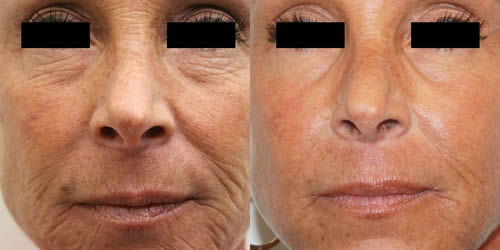
Fractional CO2 is the strongest resurfacing treatment short of fully ablative. It
genuinely resets acne scars, deep lines, sun damage and texture — and it genuinely puts you indoors
for a week. We'd rather you know that on this page than find out on day three.
Performed by Dr. Nangrani, MD — not handed to an aesthetician
About 20 minutes for a full face, under topical numbing
7–14 days of visible healing, then pink skin for 1–3 months
Dr. Nangrani assesses your skin type and what you want fixed, then tells you
whether CO2 is the right tool — and if your skin tone makes something gentler the safer choice.
4.6 on Google350+ reviews · The Woodlands since 2011
Cynosure SmartSkin CO2Fractional, micro-ablative, settings matched to your skin
Honest candidacyWe turn people away when CO2 is the wrong choice
What people come in for
CO2 is one treatment that does several things. What it's treating changes how many sessions you need — and that's where most practices are vague.
Acne scars
“I got over the acne. I didn't get over the scars.”
The biggest reason people book CO2, and the one where expectations most often go wrong. Resurfacing works on rolling and boxcar scarring by ablating columns of skin and letting new collagen fill in. The honest part: wrinkles and sun damage often respond to a single session, acne scars usually don't. Plan for a series, and judge it at six months.
Lines & texture
“Creams stopped making any difference years ago.”
Fine lines around the eyes and mouth, crepey texture, enlarged pores. CO2 at 10,600 nm is the deepest-penetrating ablative wavelength in routine use, and the residual heat tightens tissue as it heals. For photoaging and fine lines, one properly dosed session is often enough — which is the opposite of most treatments on a med spa menu.
Sun damage
“Texas happened to my face.”
Mottled pigment, brown patches and rough texture from years of sun. CO2 removes the damaged surface and prompts new collagen underneath. The catch is that it only holds if you change what caused it — new sun damage reverses the result, and we'll be blunt about the SPF commitment before you book rather than after.
Darker skin tones
“Is my skin tone a problem for this?”
Possibly, and you deserve a straight answer rather than ‘all skin types welcome’. Ablative CO2 carries a real risk of post-inflammatory hyperpigmentation in Fitzpatrick IV–VI. Type IV–V can often be treated with conservative settings and proper priming. For type VI, most experts reach for radiofrequency microneedling instead — it's electrothermal, so it doesn't target melanin at all. Mayo Clinic tells patients to ask about exactly that. If that's you, we'd rather send you to the right device.
Five things everyone asks first
In the order people actually search them.
How much downtime, honestly?
Plan on seven to ten days out of sight, ten to fourteen days before makeup covers it, and pink skin for one to three months — occasionally up to a year to fade completely, particularly if you're fair. The manufacturer's literature says five to seven days. Independent clinical sources say seven to fourteen plus months of redness, and that's the number we'd rather you plan around. The day-by-day below sets out exactly what happens.
What does it cost?
It depends on the area and how aggressive the settings need to be — full face, or just around the eyes and mouth, and whether you need one session or a series for scarring. Nobody in The Woodlands publishes a CO2 price, and we're not going to quote you one over the phone that changes when Dr. Nangrani sees your skin. You get an itemised number at your free consultation, in writing, and we run Cherry and CareCredit.
Is one session really enough?
For wrinkles and photoaging, usually yes — ablative CO2 is one of the few treatments where a single properly dosed session does the job. For acne scars, usually not. That's the distinction most pages blur, and it's why acne scar patients are the ones who feel misled. Dr. Nangrani will tell you which camp you're in before you pay for anything.
Will it leave me with dark patches?
Post-inflammatory hyperpigmentation occurs in roughly 5% of patients and the risk is meaningfully higher in medium and deep skin tones. It is driven by inflammation stimulating melanocytes, not by the laser hitting pigment. We lower it by matching settings to your skin type, priming the skin beforehand where appropriate, and being uncompromising about sun avoidance afterwards. If your risk is too high, we'll say so and offer a different device.
Who's actually doing it?
Dr. Nangrani, personally. In this category that matters more than the machine — outcomes track operator judgement more than brand, and the complications that frighten people (hypopigmentation, scarring, prolonged redness) are usually settings and technique rather than bad luck. Two of the practices advertising CO2 near The Woodlands don't name a clinician on the page at all. Ask them who's holding the handpiece.
The recovery, day by day
This is the section most pages leave out. Read it before you book — if the timeline doesn't fit your life right now, the right answer is to wait, not to rush it.
Day 0 — treatment
Topical numbing first. About 20 minutes for a full face. Afterwards it feels like a bad sunburn; ice settles the sting within an hour or two. Non-stick dressing for 24 hours.
Days 1–3 — swelling and weeping
The worst of it. Swelling peaks in the first 24–48 hours, the skin oozes and crusts, and it itches or stings. Sleep propped up. Cleanse several times a day and keep ointment on it. This is the stage that looks alarming and is completely normal.
Days 3–7 — peeling
The skin dries, goes sandpapery and starts to come away, usually days five to seven. Don't pick it. New pink skin appears underneath as it sloughs.
Days 7–14 — new skin, still pink
New skin covers the area at around seven to ten days. It's bright pink and tight. Most peeling is finished by day ten to fourteen, which is when oil-free makeup with a green-tinted colour corrector can usually go over it.
Months 1–3 — the pink fades
Redness lightens steadily over two to three months. It can take six months to a year to go completely, especially if you're fair or red-haired. Small white bumps can show up for a month. Daily broad-spectrum SPF 30+ from the moment you're healed, no exceptions.
We can't give you a return-to-work date and neither can Cleveland Clinic, Mayo or
the ASDS — none of them publish one, because it depends on your job, your skin and how aggressively
we treat. What we can tell you is what your face will look like on each of those days, which is what
you actually need in order to plan.
When you'll see the result — and how CO2 compares
Resurfacing is a family of treatments at different strengths. Stronger means better results and more downtime. There is no version of this where you get both.
Fractional CO2
Non-ablative fractional
RF microneedling
Microneedling
Strength
Strongest short of fully ablative
Moderate
Moderate
Mild
How it works
Ablates columns of skin with 10,600 nm laser
Heats without removing surface
Electrothermal — melanin not targeted
Mechanical micro-injury
Visible healing
7–14 days
2–4 days
1–3 days
Hours to 2 days
Residual redness
1–3 months, sometimes longer
Days to weeks
Days
Days
Sessions
Often 1 for lines; a series for scars
3–5
3–4
3–6
Safe in deep skin tones?
No — higher PIH risk in Fitzpatrick IV–VI
Generally yes at 1540 nm
Yes — considered safe in all skin types
Yes
Best for
Deep scarring, marked photoaging, etched lines
Tone and mild texture
Texture and laxity when CO2 is too risky
Mild texture, maintenance
Swipe the table sideways to see every column →
Timeline for the result itself: visible improvement once healing finishes at a few weeks, full result at three to six months as collagen remodels, with continued improvement up to a year. Ablative results can last years — but ageing continues and new sun damage will undo them.
Dr. Chaitali Nangrani, MD
Board-certified physician · 15+ years in aesthetic & anti-aging medicine
Dr. Nangrani has been practising in The Woodlands since 2011 and performs resurfacing treatments herself. She is a Diplomate of the American Board of Family Medicine and of the American Academy of Anti-Aging Medicine, with an advanced fellowship in aesthetic medicine.
Ablative CO2 is the one treatment on our menu where who is operating the device matters more than which device it is. The complications people are afraid of — hypopigmentation, scarring, pigment that gets worse instead of better — come overwhelmingly from settings chosen badly for the skin in front of you.
Diplomate, American Board of Family Medicine
Diplomate, American Academy of Anti-Aging Medicine
Advanced Fellowship in Aesthetic & Anti-Aging Medicine
Performs CO2 resurfacing personally — in The Woodlands since 2011
We don't publish a price for CO2, and neither does any other practice in The Woodlands — because
the number genuinely depends on what you're treating. Rather than quote you something meaningless,
here is what actually moves it.
Area treatedFull face, or a targeted zone like around the eyes and mouth. Neck and chest are priced separately.
Depth and passesDeep acne scarring needs more aggressive settings and more passes than fine lines do.
One session or a seriesPhotoaging is often one and done. Scarring usually isn't — and that changes the total.
Cherry & CareCreditPay over time. Cherry takes a couple of minutes and checking doesn't affect your credit score.
You'll get an itemised number in writing at your free consultation, before
anything is booked.
CO2 is probably right for you if…
You have acne scarring, etched lines, sun damage or rough texture
You can take seven to ten days out of sight, and soon
You'll commit to daily SPF and real sun avoidance afterwards
You're not pregnant, and not on isotretinoin
Your skin isn't currently tanned or actively breaking out
Where we'll say no, or suggest something else: deep sagging needs lifting, not
resurfacing. Active acne needs treating first. Recent sun exposure means waiting four to six weeks.
Melasma can rebound weeks after an aggressive laser, so it's handled differently. And if you're
Fitzpatrick V or VI, radiofrequency microneedling is very often the better and safer answer —
we'd rather tell you that than take the booking.
No authoritative source publishes a return-to-work figure, and anyone who gives you a confident one is guessing. Realistically: seven to ten days before you'd be comfortable being seen, ten to fourteen before makeup covers it properly. If you work from home or can take leave, people often go back sooner. If you're client-facing, plan two weeks.
How many sessions will I need for acne scars?
More than one, usually. There's no fixed number published, because it depends on scar type and depth — rolling and boxcar scars respond well, ice-pick scars often need a different approach entirely. Dr. Nangrani will look at what you actually have and give you a plan, rather than promising a single session and leaving you disappointed at month three.
Does it hurt?
During, it's managed with topical numbing — uncomfortable rather than painful, with a hot stinging sensation. Afterwards it feels like a strong sunburn for the first day or two, and ice packs take the edge off within an hour or two. We'll go through pain management at your consult.
Is this the same as Fraxel?
No, and this is worth clearing up because our own website has historically called it ‘SmartSkin CO2 Fraxel’. Fraxel is a Solta Medical trademark; SmartSkin is made by EL.EN. and distributed by Cynosure. They're different machines from different manufacturers. More importantly, the two best-known Fraxel devices are non-ablative with about a day of downtime — this is ablative CO2 with seven to fourteen. Booking one expecting the other is exactly how people end up feeling misled.
What's the difference between fractional and fully ablative CO2?
Fully ablative removes the entire skin surface uniformly — stronger, and up to two weeks or more of recovery. Fractional drills narrow columns and leaves the skin between them intact, so the untreated tissue seeds healing and recovery is shorter. Fractional is now the preferred method. One counter-intuitive caveat worth knowing: fractional CO2 penetrates more deeply, so it isn't universally gentler — it's gentler at the surface.
What should I do before the treatment?
Avoid sun and tanning for at least four weeks beforehand, stop photosensitising antibiotics like doxycycline at least 72 hours before, and don't have peels or dermabrasion in the four weeks prior. If you get cold sores we'll start an antiviral two days before. Don't smoke for a couple of weeks either side — it slows healing.
What are the real risks?
Post-inflammatory hyperpigmentation in roughly 5% of patients, and higher in deeper skin tones. Prolonged redness lasting months. Infection, including cold sore reactivation, which is why we use antivirals. Milia for up to a month. Permanent lightening of the skin and scarring are rare but real, and are associated with aggressive settings. This is a medical procedure, and we treat it as one.
Can I have it on my neck, chest or hands?
Yes — those areas are commonly treated and they age visibly. They also heal more slowly than the face and tolerate less aggressive settings, so expectations and dosing are different. We'll discuss them as separate areas.
When can I wear makeup again?
Once the peeling has finished and the skin is intact, generally day ten to fourteen. Use oil-free makeup, and a green-based colour corrector neutralises the pink far better than foundation alone. Keep to oil-free products for a couple of months while the skin settles.
How long do the results last?
Years, for the resurfacing itself. But you keep ageing, you keep squinting and smiling, and new sun damage will undo it. The patients who get a decade out of a CO2 treatment are the ones who wear sunscreen every day afterwards.
What if I'm not a candidate?
Then we'll tell you and offer the alternative that fits — radiofrequency microneedling is safe across all skin types because it's electrothermal rather than light-based, and non-ablative fractional, microneedling and superficial peels are all options depending on what you need. Turning down a booking we shouldn't take is cheaper for everyone than fixing a complication.
Book your free consultation
Dr. Nangrani looks at your skin, tells you what CO2 will and won't fix, and gives
you a real number in writing. If a gentler device is the right call for your skin tone, she'll say so.
This page is for information only and does not constitute medical advice. Individual results vary. SmartSkin+ is an FDA-cleared Class II powered laser surgical instrument (product code GEX), manufactured by EL.EN. SpA and distributed by Cynosure. Fractional ablative CO2 laser resurfacing carries real risks including post-inflammatory hyperpigmentation, prolonged redness, infection and scarring, and is not suitable for every skin type. Recovery times quoted are typical ranges, not guarantees. Dr. Chaitali Nangrani, MD is a board-certified physician; Vedas Medical Spa is a medical spa and not a plastic surgery practice. All treatments require an in-person consultation and a skin assessment.